What Is a WordPress Maintenance Plan?
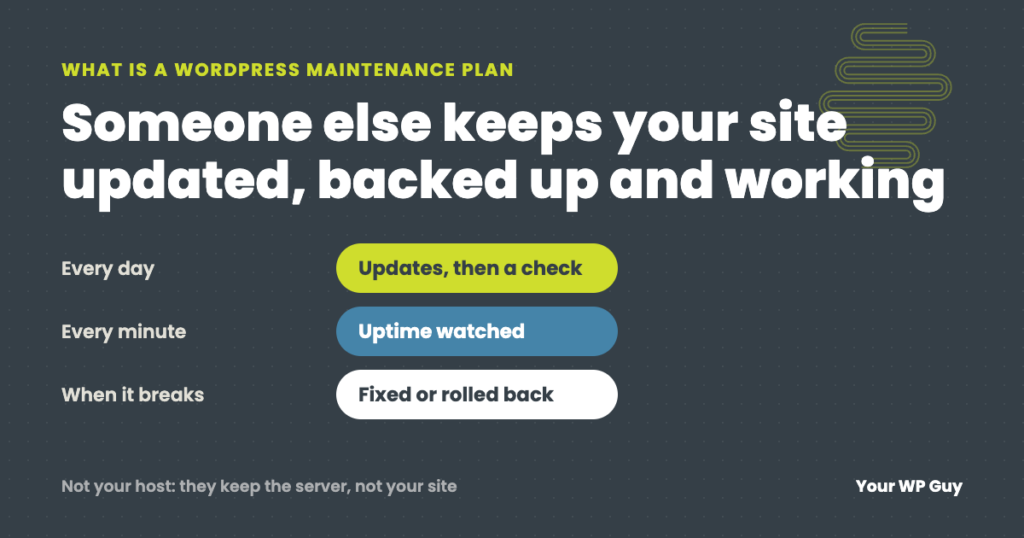
A WordPress maintenance plan is a monthly service where someone else keeps your site updated, backed up, secure and online. A good plan does more than press “update”: a person checks the site afterward, fixes what an update breaks, and can restore a backup if something goes wrong. Most plans add security monitoring, uptime alerts and a monthly report. See what our WordPress maintenance plans include.
Your website works, so why pay someone to look after it? Then a plugin updates overnight, the contact form stops sending, and nobody notices until a customer calls to ask why you never answered.
We look after WordPress sites for small businesses across the US, so this is what we see every week. This guide explains what a maintenance plan actually covers, how it differs from your hosting and from doing it yourself, what a plan does not cover, and what a normal month looks like from your side.
What does a maintenance plan include?
Almost every plan covers the same five jobs. The difference between plans is how carefully each one is done.
- Updates. WordPress itself, your theme and your plugins all release updates, many of them security fixes. A plan applies them and then checks that the site still works.
- Backups. Copies of your files and database, kept somewhere other than your server, so the site can be put back the way it was.
- Security. Malware scanning, a firewall, and someone watching for attacks and suspicious changes.
- Uptime monitoring. A service that checks your site around the clock and alerts a person when it goes down.
- Support and reporting. Someone to contact when something is wrong, and a monthly report of what was done.
Some plans add speed tuning, time for small edits, or help with online stores. When a plan includes monthly hours for content changes, some companies call it a “care plan” instead. The name matters less than the list of what is included.
What happens in a month on a plan?
Most of it you never see. That is the point. Here is what a month looks like on a plan like ours:
- Every day: updates are applied and the site is checked afterward, and a fresh backup is made and confirmed to exist.
- Every minute: the site is checked to make sure it is up. If it goes down, a person is alerted, not just a robot.
- When an update breaks something: it gets fixed, or the site is rolled back from that day’s backup while the problem is sorted out. You hear about it from us, not from a customer.
- Once a month: you get a short report in plain English: what was updated, which backups were made, what the security scans found, and anything that needs a decision from you.
The day-to-day work is the easy part. The value is in the bad day: knowing someone will notice, someone will fix it, and there is a clean copy of your site to fall back on.
Maintenance plan vs hosting vs doing it yourself
Your hosting company keeps the server running. A maintenance plan looks after the WordPress site on that server. Some managed hosts update WordPress itself, but almost none check your forms, your checkout or your layout after an update.
| Job | Doing it yourself | Typical hosting | Maintenance plan |
|---|---|---|---|
| Updates | You, when you remember | WordPress core on some managed hosts; plugins usually up to you | All of them, on a schedule |
| Checking the site after an update | You | Rarely | Yes |
| Fixing what an update breaks | You, or a developer you find that day | Not their job | Yes, on good plans |
| Backups | If you set them up | Often, kept with the same company | Daily, kept off the server |
| Restoring a backup | You | Usually a button you press | Done for you |
| Someone to call | No | A support queue | A team that knows your site |
How hosting and plans usually split the work, from the sites we have taken on (October 2026). Check your own host’s terms, because some managed hosts include more. More detail: The Top 5 Differences Between Managed Hosting and Maintenance Plans.
Doing it yourself is a real option for a simple site. WordPress can update plugins and themes automatically, and the official guides walk through manual updates and backups. What they cannot do is notice that your booking form stopped working after last night’s update.
What a maintenance plan does not cover
Most frustration with plans comes from expecting something the plan never included. Ask about these before you sign up:
- New features and redesigns. A new page layout, a new booking system or a fresh design is project work, billed separately.
- Writing content. Some plans include a little time for small edits. Very few write your pages or blog posts.
- Hack cleanup on cheap plans. Many plans spot malware but charge extra to remove it. Ask directly.
- Your hosting. Unless the plan says hosting is included, a server outage is your host’s job, not your maintenance company’s.
- Problems inside a third-party plugin. A good plan works around a broken plugin or replaces it, but only the plugin’s maker can fix its code.
On our plans, fixing what an update breaks and cleaning up a hacked site are included, and work outside the plan is billed at a discounted rate. Not every company works that way, so read the fine print.
Rather have someone handle it?
Our plans keep your site updated, backed up and watched by real people, with phone support on every plan.
- Talk to a WordPress expertA short call about your site and what it does for your business.
- We set it up within 24 hoursBackups, monitoring and security are in place from day one.
- You get back to workWe watch the site and send you a plain-English report each month.
Who needs one, and who does not?
If your website brings in calls, leads or sales, it needs looking after. The only question is whether you do it or someone else does.
- You probably need a plan if the site takes orders or bookings, uses more than a handful of plugins, was built with a page builder, or if a week of downtime would cost you real money.
- You may not if it is a simple personal site with few plugins and nothing for sale, and you are comfortable updating and testing it yourself.
Not sure which side you are on? Work out what a broken contact form or a site that is down for a week would cost you, and compare it with a monthly fee. Our website maintenance cost guide lays out what small businesses typically pay.
A real example: the site too fragile to update
A landscaping company we look after came to us with a site nobody dared update. The last time someone ran all the updates at once, the site broke so badly it had to be restored from a backup. It had been frozen on old software ever since, missing every security fix in between.
Before touching anything, we looked at how the site was built. Half of its building blocks (313 of 636) came from one page builder add-on that could not update, because its license had never been registered on the site. That mismatch was very likely what broke it last time. We registered the license, took a snapshot of every page, and brought the whole site current in one afternoon.
Then we checked all 22 pages on phone and desktop: 0 had changed. We also caught a server cache that was still serving phone visitors pages three and a half days old, and cleared it. That checking afterward is what a maintenance plan is really for.
Not ready for a plan? Our free Uh Oh Score checks your site and shows what to fix first, with no sales call required.
Get my Uh Oh ScoreQuestions people ask
Does a website need monthly maintenance?
Yes, if it runs WordPress. Updates come out every week or two, and many are security fixes. Monthly is the minimum; updates and backups work best daily, with a person checking the site afterward.
What is the difference between a maintenance plan and a care plan?
Usually very little. Both cover updates, backups, security and monitoring. Some companies use “care plan” for a maintenance plan that also includes monthly time for small edits. Compare the list of what is included, not the name.
How much does a WordPress maintenance plan cost?
It depends on the site and what the plan includes. Our website maintenance cost guide lays out typical prices, and our own plans and prices are on our maintenance plans page.
Can I do WordPress maintenance myself?
Yes. You need to update everything, check the site afterward, keep backups somewhere other than your server, and know how to restore them. Our guide on how to update WordPress safely walks through it. Most owners hand it off once they count the hours.
Does my hosting company already do this?
Partly. Hosts keep the server running, and many make backups. Some managed hosts update WordPress itself. Very few update your plugins, check your forms and pages afterward, or fix what an update breaks.
Can I still log in and edit my site on a maintenance plan?
Yes. On our plans you keep full access to your WordPress dashboard and can keep making changes. We work in the background.
What happens if my site gets hacked while I am on a plan?
That depends on the plan, so ask before you sign up. Many plans detect malware but charge extra to clean it up. On our plans, cleanup is included.
Sources
- WordPress.org, Updating WordPress.
- WordPress.org, Upgrading WordPress (Advanced Administration Handbook).
- WordPress.org, Backups (Advanced Administration Handbook).
Keep your website working while you run your business
We keep your WordPress site updated, backed up and secure, fix what breaks, and pick up the phone when you call.

Jonathan Wofford is the founder of Your WP Guy, a WordPress care and maintenance service supporting 105+ active client sites. He and his team keep WordPress sites fast, secure, and running, so business owners can stay focused on their business instead of their website.