What Is WordPress Maintenance? (What It Includes and How Often)

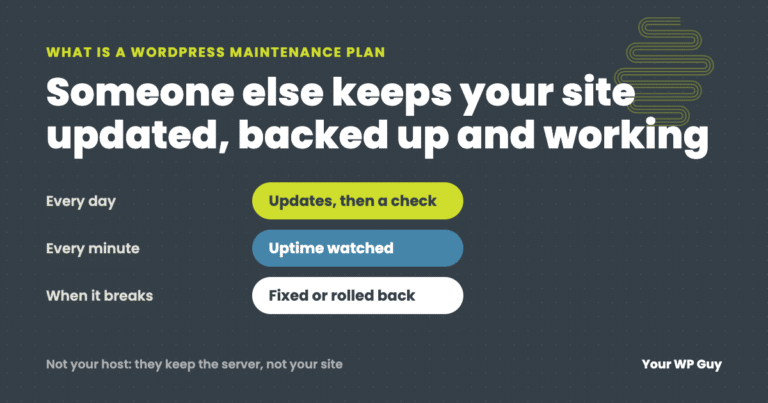
WordPress maintenance is the ongoing work that keeps a WordPress website secure, fast and working after it is built: updating WordPress, plugins and themes, making backups, watching for security problems and downtime, and fixing what breaks. It is not a one-time job, because WordPress and its plugins change every week. See how we handle WordPress maintenance for you.
Your website went live, it looks right, and it works. It is easy to assume it will keep working on its own. It will not, and usually nothing looks wrong until the day a form stops sending, the site goes down, or a visitor gets a security warning.
We maintain WordPress sites for small businesses every day, so this guide explains maintenance from the owner’s side: what it includes, the types of maintenance, how often it needs to happen, how it differs from web design, and what doing it yourself really takes.
What does WordPress maintenance include?
Maintenance covers six jobs. Each one protects something different, and skipping any of them leaves a gap:
| Job | What it means | How often it should happen |
|---|---|---|
| Updates | Installing new versions of WordPress, plugins and themes, then checking the site still works | Checked every day; security fixes as soon as they are tested |
| Backups | A copy of the files and database, stored away from the server, that you can restore | At least daily, and always before updates |
| Security | A firewall, malware scans and watching for vulnerability reports in the plugins you run | All the time, with daily scans |
| Uptime | Checking that the site actually loads, so problems are caught before customers report them | Every few minutes |
| Speed and cleanup | Clearing old data from the database, removing unused plugins, keeping pages fast | Monthly |
| Server software | Moving the site to supported versions of PHP, the language WordPress runs on | When a version nears the end of its support |
For the full task list, use our WordPress maintenance checklist.
The types of website maintenance
Every maintenance job falls into one of four types. Knowing them makes it easier to see what you are paying for, or what you are skipping:
- Preventive maintenance stops problems before they happen: updates, backups, security scans and uptime checks. It is the bulk of the work, and when it is done well, nobody notices it.
- Corrective maintenance fixes something that broke: an update that clashes with another plugin, a contact form that stops sending, a hacked page.
- Adaptive maintenance keeps the site working as the world around it changes: a new version of PHP on the server, a new WordPress version, a payment provider changing its rules.
- Improvement makes the site better: faster pages, clearer content, a new feature. It overlaps with design work, covered below.
How often does a WordPress site need maintenance?
Every day, mostly because of how fast things change. WordPress itself released three updates to version 7.1 in under three weeks (September 17 to October 6, 2026), and plugins update far more often: across the client sites we look after, we applied 1,403 plugin updates in the last 30 days.
Speed matters for security too. Patchstack found that heavily exploited WordPress vulnerabilities are mass-attacked a median of 5 hours after they are made public. A site updated once a month spends weeks open to attacks that started on day one.
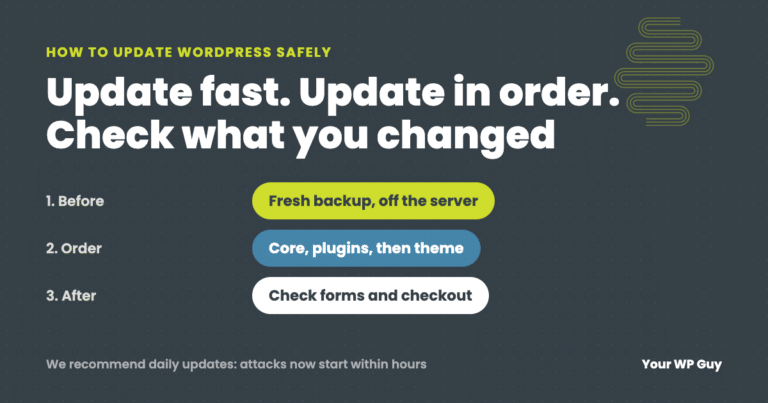
That does not mean clicking Update the moment one appears. Daily maintenance means back up, update, check the site, and fix anything that broke. Our guide covers how to update WordPress safely.
Web design vs website maintenance
Design builds the site. Maintenance keeps it running. They are often sold together, but they are different jobs:
| Compare | Web design | Website maintenance |
|---|---|---|
| When it happens | Once, or when you redesign | Every day the site is live |
| The goal | A site that looks right and brings in customers | A site that stays secure, fast and working |
| What you get | Pages, layout, branding and content | Updates, backups, monitoring, fixes and a report |
| How it is paid | A project price | Usually a monthly plan |
A well-designed site still needs maintenance from the day it launches. Plugins the designer installed keep getting updates, and a site nobody maintains slowly falls behind.
What doing it yourself involves
You can maintain a WordPress site yourself. Plenty of owners do. To do it well, you need:
- A backup you have actually restored, stored away from the server, so you know it works before you need it.
- A routine after every update: load the home page, send a test form, and run a test order if you sell online.
- A way to hear about problems first, such as uptime alerts and security notices for the plugins you run.
- Time to fix what breaks, or someone to call when an update takes the site down.
If those sound like a second job, that is the point where a WordPress maintenance plan usually makes sense.
Rather hand maintenance to someone else?
Our plans update your site every day, check it afterward, back it up three times a day, and fix anything an update breaks.
- Talk to a WordPress expertWe look at your site and what it needs to stay secure and working.
- We clean up and set upBackups, monitoring and security are in place within 24 hours.
- You get back to your businessWe handle the maintenance and send a plain-English report each month.
A real example: the 2023 plugin that broke a site in 2026
A marketing agency we look after had its server moved to a newer, supported version of PHP, a normal piece of adaptive maintenance. Six minutes later, every page on its site showed “There has been a critical error on this website.”
The cause was a speed plugin last updated in March 2023. It contained one line of code that older PHP only warned about and newer PHP refuses to run. Our checks flagged the site the next morning, but the alert sat among routine items, so visitors saw the error for close to two days before we acted on it. Once we looked, the error log named the plugin, we switched it off with the client’s go-ahead, and the site was back in about ten minutes. The plugin is now coming off the site for good.
Curious how well maintained your site is? Our free Uh Oh Score checks your site and shows what to fix first, with no sales call required.
Get my Uh Oh ScoreQuestions people ask
What does website maintenance include?
Keeping the software updated, backing up the site, watching security and uptime, cleaning up the database and keeping pages fast, and fixing anything that breaks. On WordPress, that covers WordPress itself, every plugin and the theme.
What is preventive website maintenance?
The routine work that stops problems before they happen: updates, backups, security scans and uptime checks. It is most of the maintenance work, and when it is done well, visitors never notice it.
Is WordPress free to maintain?
The WordPress software is free, but running a site is not: hosting, premium plugin and theme licenses, and the time to do the maintenance all cost something. Our guide to website maintenance cost shows what small businesses usually pay.
Does maintenance take my website offline?
Usually only for seconds. WordPress shows a short “briefly unavailable for scheduled maintenance” message while an update installs. If that message stays up, the update did not finish and needs fixing.
What PHP version should my WordPress site use?
WordPress recommends PHP 8.3 or newer (October 2026). PHP 8.2 stops getting security fixes on December 31, 2026. Your host’s control panel shows which version your site runs, and the change should be tested before it goes live.
What is website upkeep?
Another name for website maintenance: the ongoing work that keeps a site secure, current and working after it is built.
Sources
- WordPress.org, WordPress Releases and Requirements (checked October 2026).
- PHP.net, Supported Versions.
- Patchstack, State of WordPress Security in 2026.
Keep your website working as hard as you do
We update, back up, monitor and fix your WordPress site every day, so you can stay focused on your business.

Jonathan Wofford is the founder of Your WP Guy, a WordPress care and maintenance service supporting 105+ active client sites. He and his team keep WordPress sites fast, secure, and running, so business owners can stay focused on their business instead of their website.